

General program information
The Master of Science in Economics (MSE) is a modern, internationally oriented Master’s degree program that provides students with profound knowledge of economics. It is aimed at students with a strong interest in applied economics seeking a first-rate education, preparing them for a broad variety of career paths.
A special focus of the program lies on modern methods of data analysis. All core subjects and a wide range of electives are taught in English.
The MSE can be studied fully in English, and the student body is very international. Each year, around 40-50 students enroll in the master’s program, of whom about 2/3 are international.
Key facts
- Degree: Master of Science (M.Sc.) in Economics
- Specializations: Public Economics, Labor Economics, Macroeconomics and Finance, Energy Markets, Health Economics
- Standard period of study: 4 semesters (= 2 years)
- Start: October (Winter semester)
- Language: English (with some optional courses in German)
- Study abroad and/or internship: Not mandatory, but possible
- Location: Nuremberg, Germany
- Application: 15 April – 31 May each year (fully online)
Selected additional features
- Small to medium-sized classes
- Strong integration into the academic community (professors, researchers, and PhDs)
- Mentoring programs and networking opportunities
- Field trips
- Voluntary econometrics leveling course at the beginning of the first semester
You can find more information here: Experience and About WiSo
Structure of the program
The MSE is a two-year program split into four teaching terms (semesters). For graduation, students are required to earn a total of 120 ECTS. Special emphasis is placed on modern methods of data analysis and their applications across various fields in economics.
- First semester: six compulsory courses, covering the basic fields of economics (Mathematics for Economists, Applied Econometrics, Microeconomics, Game Theory, Macroeconomics: Economic Theory, and Macroeconomics: Business Cycles)
- Second and third semester: students choose courses from the specialization: Labor Economics, Public Economics, Macroeconomics and Finance, Energy Markets, and Health Economics
- Fourth semester: master’s thesis under close supervision
You can find a graphical overview here: Overview
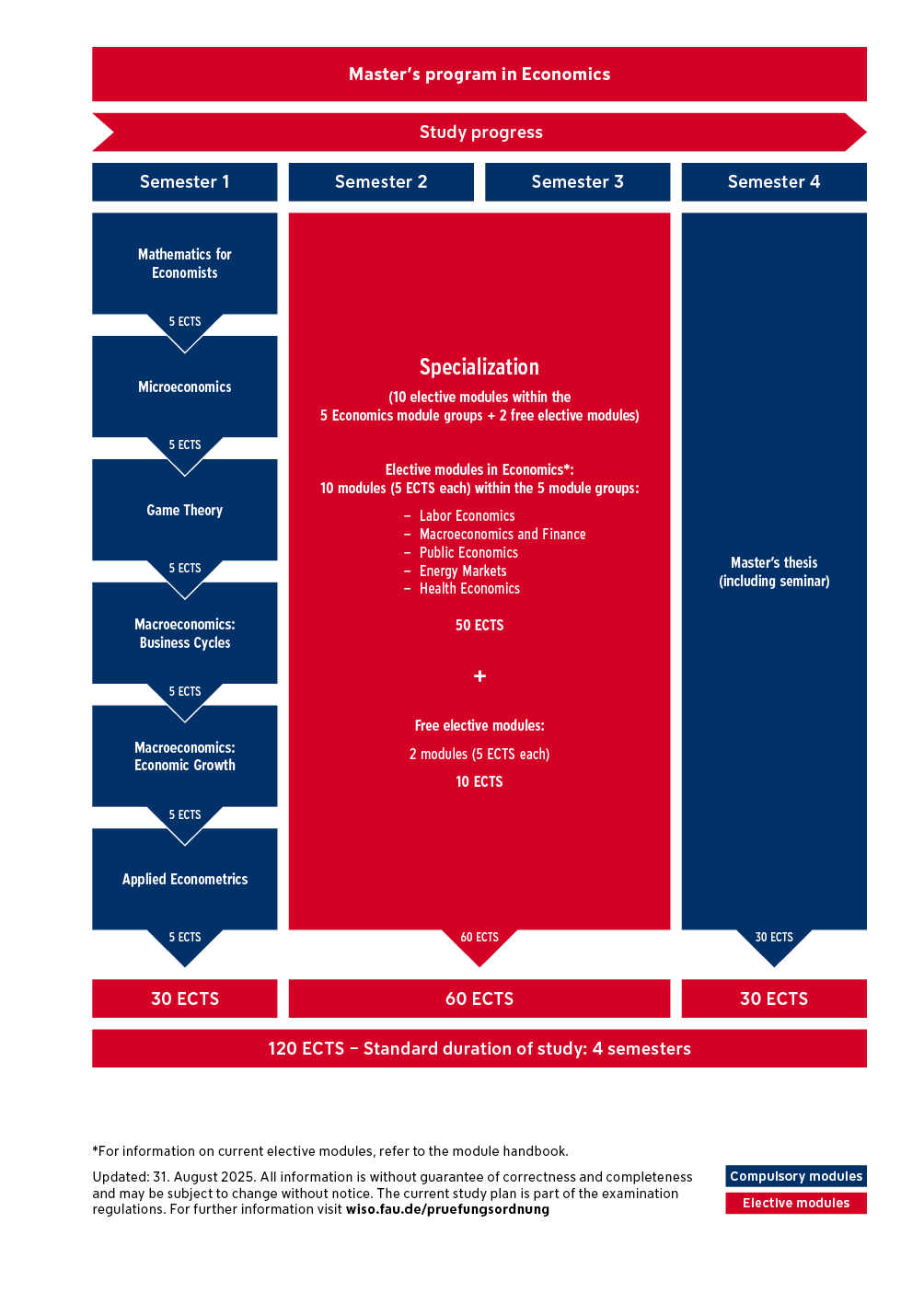
Students choose 12 courses, including at least 10 electives from economics and up to two free electives, like language courses. Participation in at least one seminar is mandatory.
Electives are grouped to form five fields of specialization:
- Labor Economics: Students explore the area of labor economics from different perspectives. They study theoretical models, delve into current empirical work on labor market issues, and learn how to apply empirical research tools to examine labor market policies.
- Public Economics: This field of specialization is focused on the analysis of tax systems and government expenditures, public finance and public policy, as well as regional, urban and development economics. Students apply microeconomic theory together with modern methods of data analysis to evaluate a variety of policies.
- Macroeconomics and Finance: This field of specialization contains macroeconomics, applied econometrics and finance. Included courses cover topics such as monetary policy, international economics, or banking, and methods such as time series econometrics or macro modelling. The field prepares for jobs at central banks and commercial banks, international organizations, and academic research.
- Energy Markets: This field of specialization considers relevant aspects of energy markets, such as market design, energy transformation towards a low-carbon system and climate policies. These issues will be addressed not only from a theoretical perspective but also using empirical methods, such as computational, econometric, and behavioural/experimental approaches.
- Health Economics: Students who specialize in this field study the supply and demand for medical services from a microeconomic perspective. Students explore a variety of markets in the health sector to learn how to optimally design a health care system.
Further, you can find a list of all courses that are currently offered in the Module Handbook.
- File Name
- FPOECO_20250320_en
- File Size
- 272 KB
- File Type
- File Name
- FPOECO_20250320_en
- File Size
- 272 KB
- File Type
- File Name
- FPOECO_20250320_en
- File Size
- 272 KB
- File Type
Student Target Group
We are looking for highly motivated students who
- have completed (or are about to complete) a Bachelor’s degree in economics or related fields
- are interested in obtaining a high-quality education in economics
- have a strong background in econometrics, statistics, and mathematical methods
- have a solid understanding of modern economic theory
- enjoy a diverse and international community
You can find more information on the admission requirements here: Admission
Skills learned
As a student in the MSE program, you will develop:
- The ability to analyze economic problems independently and work on solutions both on your own and as part of a team
- A solid understanding of modern economic theory and skills in modern data analysis
- Strong skills in empirical and quantitative methods, with a clear focus on applying these tools to real-world economic questions
- The capacity to conduct independent academic work, including developing research questions, applying appropriate methods, and presenting results clearly
You can find more information on career opportunities here: Experience and About WiSo